‘Amy Doncaster’

Flowers rose-pink, reputed to be slightly darker than ‘Riverslea’.

Seedling; found by Mrs Amy Doncaster in her garden at Chandlers Ford (Southampton, Hampshire, England); introduced by McPenny’s (Bransgore, Christchurch, Dorset) in 1978 as E. carnea, and also labelled in their nursery E. arborea.

Named after the finder, Amy (née Baring), the second wife of Edwin Doncaster, who had a fine garden at Chandlers’ Ford, Hampshire (The garden 107: 5-10 (1982); Yearbook of The Heather Society 3 (8): 44-45 (1990)). Yearbook of The Heather Society 2 (9): 65-66 (1980); __ 3 (2): 67 (1984).
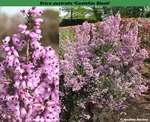
‘Castellar Blush’

Pale pink flowers, IV–VI; mid-green foliage; tall, rather open habit; height at least 1m; spread 75–100cm.

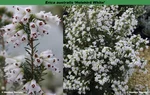
‘Holehird White’

IV–V, flowers with pale green, downy sepals, and dark brown anthers; dark green foliage; erect; height at least 1m; spread 75–100cm. A sport on ‘Holehird’ from the Lakeland Horticultural Society’s garden at Windermere, Cumbria; discovered by Russel Hope Simpson in 1987

‘Holehird’

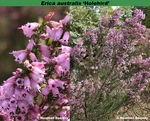
Lilac-pink (H11) flowers, IV–VI, slightly larger than those of ‘Riverslea’; height at least 1m; spread 75–100cm. From the Lakeland Horticultural Society’s garden, Holehird, at Windermere, Cumbria.

‘Mr Robert’

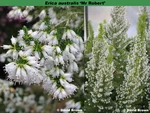
Flowers white;IV–VI; light green foliage; loose, upright habit; height at least 1m; spread 75–100cm. One of the finest of all heathers.

Collected by Lieut. Robert Williams (Caerhays, Cornwall) at Algeciras in southern Spain.

Named after Robert Williams. Lieutenant Williams was killed early in during World War I. (2nd Lieut R Williams (2nd Battalion of the Grenadier Guards), buried in Vermelles British Cemetery, died 8 October 1915, in Battle of Loos.)

‘Polar Express’

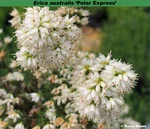
Flowers single, in groups of four at tips of shoots, flowering shoots very densely crowded towards ends of branches; corolla c. 9mm long, white, slightly curved, widening towards mouth; calyx segments unequal, with broad translucent margins and pale green mid-rib, lobes c. 3mm long, c. 1.5mm broad; anthers brown; style to 9mm long prominently emerging from corolla, style end green when fresh; nectar profuse; IV-VI; foliage deep green; linear leaves to 6mm long; habit compact bushy shrub to 0.9m tall, to 1m across in 3 years (not pruned).

Seedling 05-2-20 raised by K. Kramer in 2005, F2 seedling of self-pollinated ‘Mr Robert’. Selected  and named by David Edge in 2016 after cultivation in Forest Edge Nurseries. Hardier than other clones of E. australis having survived a frost test as a seedling in Germany. Distinguished from ‘Mr Robert’ and ‘Holehird White’ by green style end.

® E.2016:07: registered on 21 December 2016 by David Edge, Forest Edge Nurseries, Wimborne, Dorset.

‘Riverslea’

Lilac-pink (H11) flowers, IV–VI; dark green foliage; height at least 1m; spread 75–100cm. Outstanding, but requires to be well pruned to avoid it becoming straggly.

Possible seedling; found by Aubrey Pritchard (Maurice Pritchard & Sons, Riverslea Nursery, Christchurch, Hampshire, England), and introduced by Pritchard’s Nursery before 1946. Also available from Maxwell & Beale (Broadstone, Dorset) in 1946.

Riverslea was the name of Pritchard’s nursery. It is one word, not two

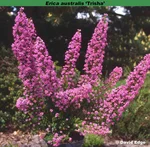
‘Trisha’

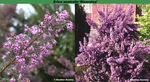
❁ Semi-double (the corolla has up to 6(–9) lobes) lilac-pink (H11) flowers, with <9 unequal, free sepals; bract and bracteoles stained dark red; III–V; foliage sage-green; bushy, well-branched, erect habit. Seedling raised by Kurt Kramer (Edewecht, Germany) and selected for naming by David Edge (Forest Edge Nurseries, Dorset).

Named after Trisha Hardy, manageress at Forest Edge Nurseries.

® E.2007.01 registered 10 January 2007 by David Edge, Forest Edge Nurseries, Woodlands, Wimborne, Dorset.